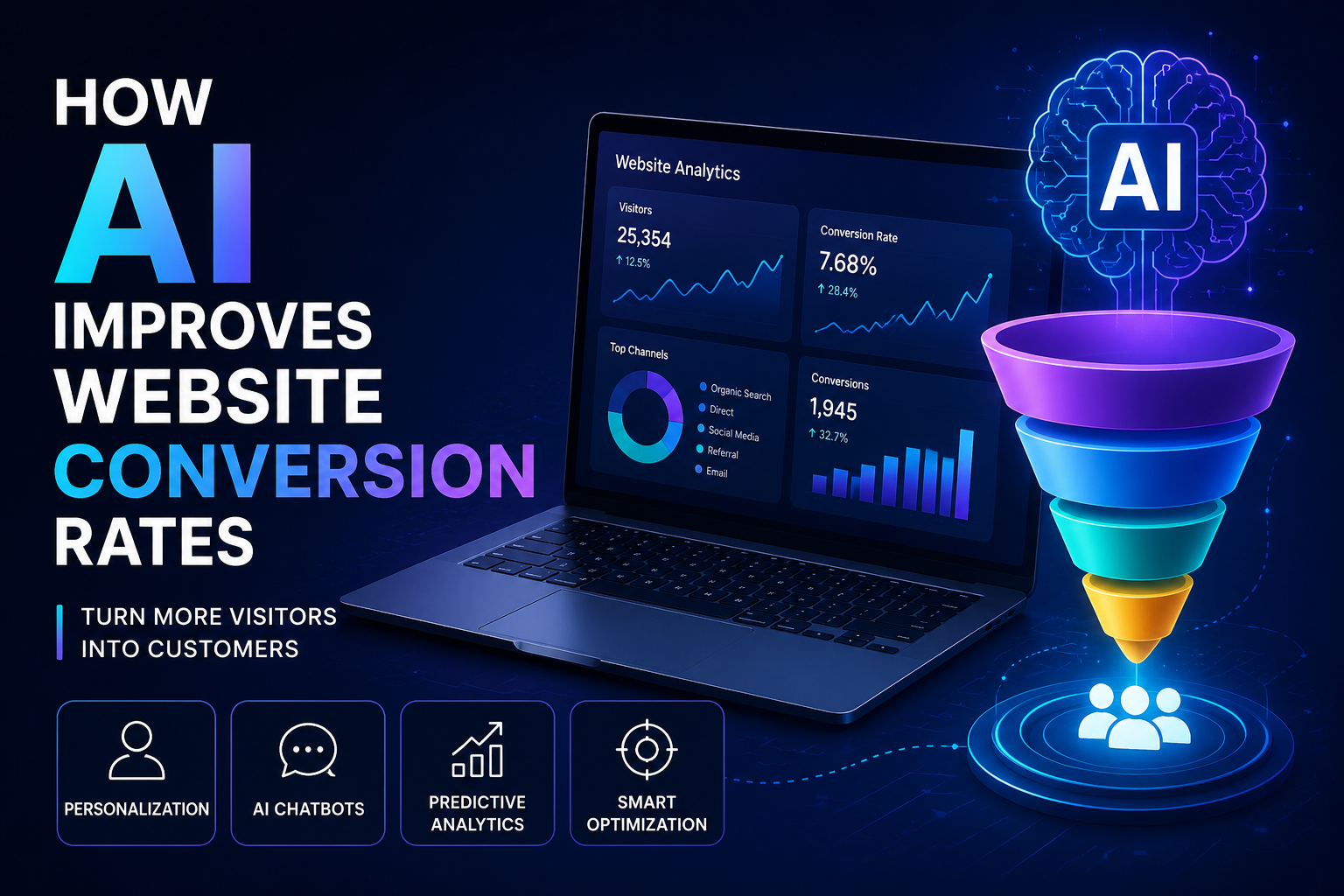
Every Click Matters
Imagine two websites selling the same product.The first website shows every visitor the exact same content.The second website understands what each visitor wants, recommends relevant products, answers questions instantly, and removes friction from the buying process.Which website is more likely to make a sale?The answer is obvious—the AI-powered website.Artificial Intelligence has transformed websites from static pages into intelligent experiences that learn, adapt, and convert visitors into customers.In this guide, you’ll learn exactly how AI improves website conversion rates and why businesses that adopt AI are seeing better engagement, more leads, and higher sales.
What Is Website Conversion Rate?
A website conversion happens when a visitor completes a desired action, such as:
- Purchasing a product
- Filling out a contact form
- Booking a consultation
- Downloading an ebook
- Signing up for a newsletter
- Starting a free trial
AI Personalizes Every Visitor’s Experience

Traditional websites display identical content to everyone.
AI changes this completely.
It analyzes visitor behavior in real time, including:
- Browsing history
- Device type
- Location
- Previous purchases
- Time spent on pages
- Click patterns
Then it delivers personalized experiences such as:
- Recommended products
- Customized landing pages
- Relevant offers
- Personalized emails
- Dynamic website content
Result
Visitors find what they need faster, increasing the likelihood of conversion.
AI Chatbots Convert Visitors 24/7
Visitors often leave because they cannot quickly find answers.
AI chatbots solve this problem by providing instant support.
They can:
- Answer common questions
- Recommend products
- Schedule appointments
- Collect leads
- Guide users through purchases
- Reduce cart abandonment
Unlike human agents, AI works around the clock.This means potential customers receive immediate assistance at any time.Smarter Product RecommendationsThink about platforms like Netflix or Amazon.They use AI recommendation engines to predict what users are most likely to want.Your website can do the same.
AI recommends products based on:
- Purchase history
- Browsing behavior
- Similar customer interests
- Seasonal trends
- User preferences
Benefits
- Higher average order value
- Better customer experience
- More repeat purchases
- Increased revenue
Predictive Analytics Helps You Sell More
AI doesn’t just analyze the past.It predicts future customer behavior.Businesses use predictive analytics to identify:
- Visitors likely to buy
- Customers at risk of leaving
- High-value prospects
- Best-performing marketing campaigns
- Peak buying times
This enables smarter marketing decisions and higher conversion rates.
AI Heatmaps Reveal User Behavior

Traditional analytics show numbers.
AI heatmaps reveal exactly where visitors:
- Click
- Scroll
- Pause
- Leave the page
Businesses can then optimize:
- Call-to-action buttons
- Page layouts
- Images
- Headlines
- Forms
Small design improvements often lead to substantial increases in conversions.
AI Optimizes Landing Pages Automatically
Instead of manually testing dozens of page versions, AI can:
- Test headlines
- Compare CTA buttons
- Evaluate images
- Optimize page layouts
- Improve color combinations
- Select the highest-performing design
Continuous optimization ensures the website keeps improving over time.
AI Reduces Cart Abandonment
Many online shoppers add products to their cart but never complete the purchase.
AI helps recover these potential customers by:
- Sending reminder emails
- Offering personalized discounts
- Detecting checkout issues
- Simplifying the buying process
- Predicting abandonment before it happens
Recovering even a small percentage of abandoned carts can significantly boost revenue.
AI Makes Forms Easier to Complete
Long or confusing forms often discourage users.
AI improves form completion by:
- Auto-filling information
- Detecting errors instantly
- Providing smart suggestions
- Reducing unnecessary fields
- Predicting user input
The easier a form is to complete, the more leads you’ll generate.
AI Improves SEO and User Experience
AI also enhances search visibility by:
- Optimizing content
- Suggesting better keywords
- Improving page speed
- Enhancing readability
- Organizing internal links
- Recommending better content structures
More organic traffic combined with better user experience leads to higher conversions.
Best AI Tools for Website Optimization ChatGPT
- Google Gemini
- Claude AI
- HubSpot AI
- Jasper AI
- Surfer SEO
- Hotjar AI
- Optimizely
- Crazy Egg
- Unbounce Smart Traffic
These tools help businesses automate optimization, improve user experience, and increase conversions.
Final Thoughts
Artificial Intelligence is no longer a luxury for websites—it’s becoming a competitive necessity. By understanding visitor behavior, personalizing experiences, automating support, and continuously optimizing pages, AI helps businesses convert more visitors into loyal customers.Whether you run an eCommerce store, a service-based business, or a blog, implementing AI-driven features can improve engagement, reduce friction, and ultimately boost your conversion rate. The earlier you adopt AI, the stronger your advantage will be in an increasingly competitive digital landscape.
FAQs
1. What is AI website optimization?
AI website optimization uses artificial intelligence to improve user experience, personalize content, and increase conversions through data-driven decisions.
2. Can AI increase website sales?
Yes. AI can improve personalization, product recommendations, customer support, and marketing, leading to higher sales and better conversion rates.
3. Is AI useful for small businesses?
Absolutely. Many affordable AI tools help small businesses automate tasks, improve customer interactions, and compete more effectively online.
4. Which AI tool is best for website conversions?
The best choice depends on your goals. ChatGPT is great for content, HubSpot AI for CRM, Hotjar AI for behavior analysis, and Unbounce Smart Traffic for landing page optimization.
5. Does AI improve SEO?
Yes. AI assists with keyword research, content optimization, technical SEO, and user experience improvements, all of which contribute to better search rankings and higher conversion potential.