The Way Businesses Work Is Changing
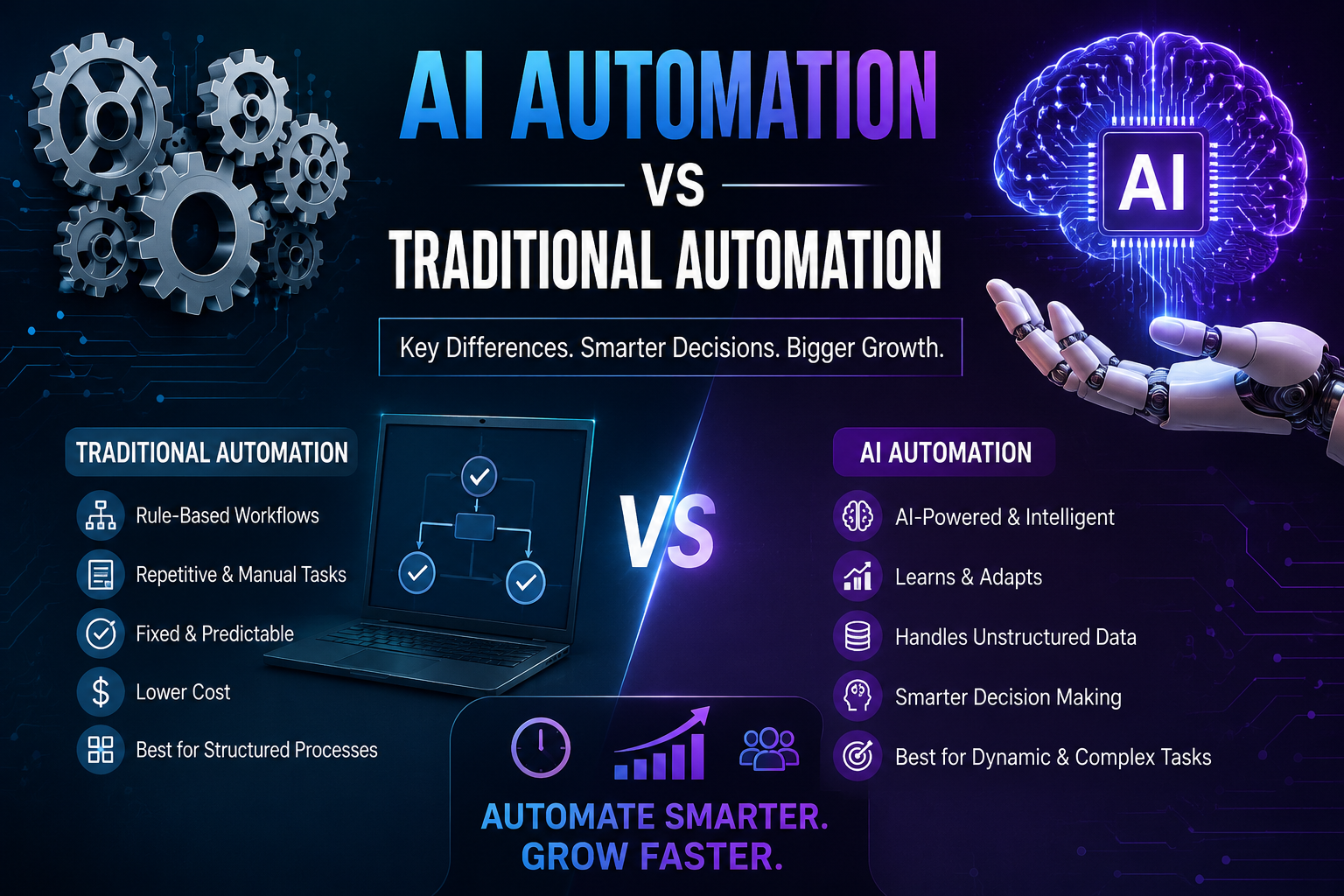
Imagine running a business where repetitive tasks are completed automatically, customer inquiries are answered instantly, reports are generated in seconds, and your team focuses only on high-value work.This isn’t a vision of the future—it’s already happening.Businesses worldwide are investing in automation to increase productivity, reduce operational costs, and deliver better customer experiences. But choosing the right type of automation is more important than ever.Should you rely on Traditional Automation, or is AI Automation the smarter investment?Let’s explore the differences.
Why Traditional Automation Has Been the Foundation of Modern Businesses
Traditional Automation follows predefined rules.If a specific condition is met, the system performs a predefined action. It works exceptionally well for repetitive, structured, and predictable tasks.
For example:
- Automatically sending welcome emails
- Processing payroll
- Updating CRM records
- Generating invoices
- Scheduling recurring reports
Because every workflow follows fixed rules, Traditional Automation is highly reliable and efficient.
Benefits of Traditional Automation
- Fast execution
- Lower implementation cost
- Consistent results
- Easy maintenance
- Perfect for repetitive workflows
However, it has one major limitation.It cannot think, understand context, or adapt when situations change.
AI Automation Takes Automation to the Next Level
AI Automation doesn’t just follow rules.It analyzes information, understands context, recognizes patterns, and continuously improves through data.Instead of asking:“What rule should I follow?”AI asks:“What is the best decision based on the available information?”This makes AI Automation ideal for complex business operations.
Examples include:
- AI Customer Support
- Smart Email Classification
- Lead Scoring
- Content Creation
- Predictive Analytics
- Personalized Marketing
- Document Analysis
- AI Assistants
Unlike Traditional Automation, AI can adapt to changing situations and improve over time.
Where Traditional Automation Still Wins
Not every business process requires Artificial Intelligence.Traditional Automation remains the best choice for:
- Payroll Processing
- Invoice Management
- Employee Onboarding
- Database Synchronization
- File Transfers
- Scheduled Notifications
- Standard Reporting
These processes rarely change and benefit from predictable automation.
Where AI Automation Creates Competitive Advantage
Modern businesses generate enormous amounts of data every day.AI helps transform that data into smarter decisions.Businesses now use AI to:
- Predict customer behavior
- Create marketing content
- Recommend products
- Detect fraud
- Qualify leads automatically
- Improve customer support
- Analyze sales trends
- Generate business insights
Instead of replacing employees, AI empowers teams to accomplish more in less time.
The Smartest Businesses Combine Both
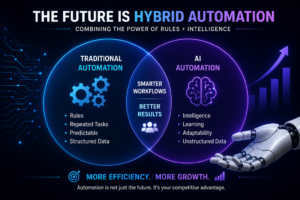
Many organizations believe they must choose between AI and Traditional Automation.In reality, the highest-performing companies use both.A practical example:
Traditional Automation
- Lead enters CRM
- Invoice is generated
- Welcome email is sent
- Meeting reminder is scheduled
AI Automation
- Evaluate lead quality
- Personalize email content
- Generate proposals
- Analyze customer intent
- Recommend the next sales action
Together, they create a powerful Intelligent Automation strategy.
Which Automation Is Right for Your Business?
Choose Traditional Automation if your business relies on:
- Fixed workflows
- Repetitive tasks
- Structured data
- Stable business processes
Choose AI Automation if you need:
- Smarter decision-making
- Customer personalization
- Intelligent customer support
- Predictive analytics
- Dynamic workflows
- Business scalability
For most growing businesses, combining both delivers the best results.
Final Thoughts
Traditional Automation remains essential for predictable and repetitive operations.AI Automation expands those capabilities by adding intelligence, adaptability, and decision-making Instead of viewing them as competitors, think of them as complementary technologies.Businesses that combine rule-based automation with AI-powered intelligence will be better positioned to scale, innovate, and succeed in the years ahead.